Palm oil declined on concern that stockpiles in Malaysia, the second-largest grower, may increase as exports slow after the end of the festival season.
The November-delivery contract dropped 1.1 percent to 3,018 ringgit ($1,013) per metric ton on the Malaysia Derivatives Exchange. Futures gained 2.5 percent last week, the first increase in six weeks.
Shipments from Malaysia may ease as importers stocked up ahead of the Muslim festival of Eid, celebrated last week. Malaysia’s palm oil exports fell 0.6 percent to 1.62 million tons in August compared with the previous month, independent market surveyor Intertek said Sept. 2. Shipments dropped 0.5 percent in the month, Societe Generale de Surveillance estimated on Aug. 29.
“Exports will be lower, as pre-stocking was already done in July,” Arhnue Tan, senior investment analyst at ECM Libra Capital Sdn., said by phone from Kuala Lumpur today. “The resulting impact could see stock levels go up. This will be bad news” for prices, she said.
Stockpiles dropped to 2 million tons in July from 2.05 million tons in June, while exports rose 9.1 percent to a record 1.73 million tons, the Malaysian Palm Oil Board said on Aug. 10. Production slipped 0.1 percent to 1.75 million tons in July. The board is scheduled to release output, inventory and shipment data for August on Sept. 12.
“Exports for August were much lower than industry expectations,” said Vimala Reddy, an analyst at Karvy Comtrade Ltd., said by phone from the Indian city of Hyderabad. “Bulk demand for edible oil is gradually decreasing. The main festive season has already come to an end.”
Demand would pick up again in a month’s time as the Hindu Diwali festival is celebrated at the end of October, Reddy said.
Soybean futures for November delivery climbed 11.25 cents, or 0.8 percent, to $14.4575 a bushel in Chicago on Sept. 2, capping a weekly gain of 1.6 percent, the third straight. All U.S. markets and government offices are closed today, in observance of Labor Day.
Palm oil for May delivery on the Dalian Commodity Exchange shed 0.5 percent to close at 8,996 yuan ($1,408) per ton, while soybean oil for delivery in the same month fell 0.6 percent to 10,426 yuan a ton.
Tuesday, 6 September 2011

Copper Declines to One-Week Low as Slowing Economies May Cut Into Demand
Copper fell to a one-week low in London on speculation slumping economies will reduce demand.
An index of investor confidence in the euro region declined to a two-year low this month, Limburg, Germany Sentix said today. The MSCI World (MXWO) Index of shares fell 2.1 percent today.
“It’s more just the feeling that the macro outlook is weaker,” Jim Lennon, global head of commodities research at Macquarie Group Ltd. in London, said by phone.
Copper for three-month delivery declined $116, or 1.3 percent, to $8,960 a metric ton on the London Metal Exchange, the lowest closing price since Aug. 24. Copper for December delivery dropped 6.35 percent, or 1.5 percent, to $4.061 a pound on the Comex in New York by 6:40 p.m. in London.
Prices fell after German Chancellor Angela Merkel’s party suffered its fifth election loss this year following a campaign based on her handling of the euro-area debt crisis. Germany’s top constitutional court will rule on Sept. 7 in three cases challenging the country’s participation in a bailout of Greece and the euro-area rescue fund.
“Focus this week is likely to switch to the EU debt situation again as Germany’s government is voting on the EU bailout fund,” William Adams, an analyst at Basemetals.com in London, wrote in a report.
Stronger Dollar
Metals also declined as the U.S. Dollar Index headed for its longest winning streak since January, making dollar-priced commodities more expensive in terms of other monies.
Nickel for three-month delivery on the LME led declines among the six main metals traded on the exchange, falling 2.8 percent to $20,895 a ton. Zinc retreated 1.1 percent to $2,172 a ton, the lowest settlement since Aug. 22.
Aluminum dropped 2 percent to $2,387.50 a ton, lead slid 1 percent to $2,435 a ton and tin fell 1.2 percent to $23,950 a ton.
An index of investor confidence in the euro region declined to a two-year low this month, Limburg, Germany Sentix said today. The MSCI World (MXWO) Index of shares fell 2.1 percent today.
“It’s more just the feeling that the macro outlook is weaker,” Jim Lennon, global head of commodities research at Macquarie Group Ltd. in London, said by phone.
Copper for three-month delivery declined $116, or 1.3 percent, to $8,960 a metric ton on the London Metal Exchange, the lowest closing price since Aug. 24. Copper for December delivery dropped 6.35 percent, or 1.5 percent, to $4.061 a pound on the Comex in New York by 6:40 p.m. in London.
Prices fell after German Chancellor Angela Merkel’s party suffered its fifth election loss this year following a campaign based on her handling of the euro-area debt crisis. Germany’s top constitutional court will rule on Sept. 7 in three cases challenging the country’s participation in a bailout of Greece and the euro-area rescue fund.
“Focus this week is likely to switch to the EU debt situation again as Germany’s government is voting on the EU bailout fund,” William Adams, an analyst at Basemetals.com in London, wrote in a report.
Stronger Dollar
Metals also declined as the U.S. Dollar Index headed for its longest winning streak since January, making dollar-priced commodities more expensive in terms of other monies.
Nickel for three-month delivery on the LME led declines among the six main metals traded on the exchange, falling 2.8 percent to $20,895 a ton. Zinc retreated 1.1 percent to $2,172 a ton, the lowest settlement since Aug. 22.
Aluminum dropped 2 percent to $2,387.50 a ton, lead slid 1 percent to $2,435 a ton and tin fell 1.2 percent to $23,950 a ton.
Gold Rises as Growth, Debt Concerns Boost Demand
Gold rose above $1,900 an ounce on speculation that economic growth will slow and Europe’s debt woes will worsen, boosting demand for a protection of wealth.
European equities dropped after an election loss for German Chancellor Angela Merkel’s party spurred concern that support for bailing out Europe’s indebted nations may fade. Bullion jumped 3.1 percent on Sept. 2, the most in almost four weeks, as data showed the U.S. jobs market stalled in August, prompting renewed speculation that the country’s economy may be headed for a recession.
“With the implications of Friday’s U.S. payrolls report and intense focus on European sovereign issues this week, gold has two strong reasons to rally,” Edel Tully, a London-based analyst at UBS AG, wrote in a report. “Additional evidence of U.S. economic weakness raises the likelihood that the Federal Reserve will announce further easing this month. As European woes reclaim center-stage and in turn investor nervousness extends, these factors will support gold in the coming weeks.”
Gold for immediate delivery gained $17.82, or 0.9 percent, to $1,900.70 an ounce by 7:06 p.m. in London, after touching $1,903.52. The metal set a record at $1,913.50 on Aug. 23. In New York, gold futures for December delivery were up $26, or 1.4 percent, at $1,902.90 on the Comex, after touching $1,908.40. Floor trading in the U.S. was closed today for the Labor Day holiday.
The metal fell to $1,895 in the afternoon “fixing” in London, used by some mining companies to sell output, from $1,896.50 at this morning’s fixing.
Bull Market
Bullion is in the 11th year of a bull market, the longest winning streak since at least 1920 in London, as investors seek to diversify away from equities and some currencies. The metal is up 33 percent this year, outperforming global stocks, commodities and Treasuries. The metal climbed to a record priced in euros and British pounds today.
Merkel’s party yesterday suffered its fifth election loss this year after the chancellor failed to sway voters in her home state with a campaign based on her handling of the euro area’s debt crisis. European investor confidence fell to the lowest level in more than two years in September, a report showed today.
European sovereign-debt risk rose to a record based on closing prices, according to traders of credit-default swaps. World Bank President Robert Zoellick said in Beijing on Sept. 3 that the global economy is entering a “new danger zone” amid Europe’s debt difficulties.
Growth Concerns
“U.S. growth concerns and euro-zone debt concerns continue to overshadow markets,” James Moore, an analyst at TheBullionDesk.com in London, wrote in a report. Gold will be supported by “investors seeking to diversify from the volatile flows in equities.”
Gold exchange-traded-product holdings fell for a third day on Sept. 2, declining 1.7 metric tons to 2,142.4 tons, data compiled by Bloomberg show. Assets reached a record 2,216.8 tons on Aug. 8.
Silver for immediate delivery declined 0.5 percent to $43.0375 an ounce. Platinum rose 0.2 percent to $1,888 an ounce. Gold’s rally pushed its price above platinum today. An ounce of platinum bought 1.19 ounces of gold on average this year, data compiled by Bloomberg show. Palladium fell 1.3 percent to $764.50 an ounce.
European equities dropped after an election loss for German Chancellor Angela Merkel’s party spurred concern that support for bailing out Europe’s indebted nations may fade. Bullion jumped 3.1 percent on Sept. 2, the most in almost four weeks, as data showed the U.S. jobs market stalled in August, prompting renewed speculation that the country’s economy may be headed for a recession.
“With the implications of Friday’s U.S. payrolls report and intense focus on European sovereign issues this week, gold has two strong reasons to rally,” Edel Tully, a London-based analyst at UBS AG, wrote in a report. “Additional evidence of U.S. economic weakness raises the likelihood that the Federal Reserve will announce further easing this month. As European woes reclaim center-stage and in turn investor nervousness extends, these factors will support gold in the coming weeks.”
Gold for immediate delivery gained $17.82, or 0.9 percent, to $1,900.70 an ounce by 7:06 p.m. in London, after touching $1,903.52. The metal set a record at $1,913.50 on Aug. 23. In New York, gold futures for December delivery were up $26, or 1.4 percent, at $1,902.90 on the Comex, after touching $1,908.40. Floor trading in the U.S. was closed today for the Labor Day holiday.
The metal fell to $1,895 in the afternoon “fixing” in London, used by some mining companies to sell output, from $1,896.50 at this morning’s fixing.
Bull Market
Bullion is in the 11th year of a bull market, the longest winning streak since at least 1920 in London, as investors seek to diversify away from equities and some currencies. The metal is up 33 percent this year, outperforming global stocks, commodities and Treasuries. The metal climbed to a record priced in euros and British pounds today.
Merkel’s party yesterday suffered its fifth election loss this year after the chancellor failed to sway voters in her home state with a campaign based on her handling of the euro area’s debt crisis. European investor confidence fell to the lowest level in more than two years in September, a report showed today.
European sovereign-debt risk rose to a record based on closing prices, according to traders of credit-default swaps. World Bank President Robert Zoellick said in Beijing on Sept. 3 that the global economy is entering a “new danger zone” amid Europe’s debt difficulties.
Growth Concerns
“U.S. growth concerns and euro-zone debt concerns continue to overshadow markets,” James Moore, an analyst at TheBullionDesk.com in London, wrote in a report. Gold will be supported by “investors seeking to diversify from the volatile flows in equities.”
Gold exchange-traded-product holdings fell for a third day on Sept. 2, declining 1.7 metric tons to 2,142.4 tons, data compiled by Bloomberg show. Assets reached a record 2,216.8 tons on Aug. 8.
Silver for immediate delivery declined 0.5 percent to $43.0375 an ounce. Platinum rose 0.2 percent to $1,888 an ounce. Gold’s rally pushed its price above platinum today. An ounce of platinum bought 1.19 ounces of gold on average this year, data compiled by Bloomberg show. Palladium fell 1.3 percent to $764.50 an ounce.
Crude Oil Extends Drop on Signs of Slowing U.S. Economy, Rising Stockpiles
Oil extended declines in New York as investors speculated that signs of a weakening U.S. economy and increasing crude stockpiles indicate fuel demand will falter in the world’s biggest consumer of the commodity.
Futures slid as much as 3.8 percent before a report today that may show service industries grew at the slowest pace in more than a year. Crude supplies at Cushing, Oklahoma, the delivery point for West Texas Intermediate oil, rose 2.4 percent on Sept. 1 from Aug. 31, according to DigitalGlobe Inc. London- traded Brent widened its premium to U.S. prices.
“Oil benchmarks slipped again as fears of slowing global growth weighed on demand sentiment,” Mark Pervan, head of commodity research at Australia & New Zealand Banking Group Ltd. in Melbourne, said in a note today. “Oil prices should primarily take direction from equity markets, so expect further selling pressure this week as markets remain jittery ahead of major policy discussions.”
Crude for October delivery fell as much as $3.25 to $83.20 a barrel in electronic trading on the New York Mercantile Exchange and was at $83.75 at 10:30 a.m. Sydney time. Floor trading was closed yesterday for the Labor Day holiday and electronic trades will be booked with today’s transactions for settlement purposes. The contract slipped 2.8 percent to $86.45 a barrel on Sept. 2. Prices are 12 percent higher the past year.
Brent oil for October settlement was at $110.13, up 5 cents, on the London-based ICE Futures Europe exchange. The European benchmark was at a premium of $26.38 to U.S. futures, compared with a record close of $26.21 on Aug. 19.
Cushing Supplies
Crude stockpiles held in floating-roof tanks at Cushing rose 850,000 barrels to 35.6 million, satellite images taken by Longmont, Colorado-based DigitalGlobe show. The Energy Department said last week that supplies, including floating and fixed tanks, totaled 33.1 million barrels as of Aug. 26.
The Institute for Supply Management’s non-manufacturing index fell to 51 last month, the lowest since January 2010, from 52.7 in July, according to the median of 59 forecasts in a Bloomberg News survey before a release today. Citigroup Inc. cut its 2011 global economic growth forecast yesterday to 3.1 percent from 3.7 percent.
Japan’s Nikkei 225 benchmark stock index fell 1.2 percent in Tokyo trading and Australia’s S&P/ASX 200 slid 1.5 percent in Sydney today as concern that Europe’s debt crisis is worsening sapped demand for riskier assets.
Futures slid as much as 3.8 percent before a report today that may show service industries grew at the slowest pace in more than a year. Crude supplies at Cushing, Oklahoma, the delivery point for West Texas Intermediate oil, rose 2.4 percent on Sept. 1 from Aug. 31, according to DigitalGlobe Inc. London- traded Brent widened its premium to U.S. prices.
“Oil benchmarks slipped again as fears of slowing global growth weighed on demand sentiment,” Mark Pervan, head of commodity research at Australia & New Zealand Banking Group Ltd. in Melbourne, said in a note today. “Oil prices should primarily take direction from equity markets, so expect further selling pressure this week as markets remain jittery ahead of major policy discussions.”
Crude for October delivery fell as much as $3.25 to $83.20 a barrel in electronic trading on the New York Mercantile Exchange and was at $83.75 at 10:30 a.m. Sydney time. Floor trading was closed yesterday for the Labor Day holiday and electronic trades will be booked with today’s transactions for settlement purposes. The contract slipped 2.8 percent to $86.45 a barrel on Sept. 2. Prices are 12 percent higher the past year.
Brent oil for October settlement was at $110.13, up 5 cents, on the London-based ICE Futures Europe exchange. The European benchmark was at a premium of $26.38 to U.S. futures, compared with a record close of $26.21 on Aug. 19.
Cushing Supplies
Crude stockpiles held in floating-roof tanks at Cushing rose 850,000 barrels to 35.6 million, satellite images taken by Longmont, Colorado-based DigitalGlobe show. The Energy Department said last week that supplies, including floating and fixed tanks, totaled 33.1 million barrels as of Aug. 26.
The Institute for Supply Management’s non-manufacturing index fell to 51 last month, the lowest since January 2010, from 52.7 in July, according to the median of 59 forecasts in a Bloomberg News survey before a release today. Citigroup Inc. cut its 2011 global economic growth forecast yesterday to 3.1 percent from 3.7 percent.
Japan’s Nikkei 225 benchmark stock index fell 1.2 percent in Tokyo trading and Australia’s S&P/ASX 200 slid 1.5 percent in Sydney today as concern that Europe’s debt crisis is worsening sapped demand for riskier assets.
Gold Rises Above $1,900 an Ounce as Growth, Debt Concerns Enhance Demand
Gold, trading above $1,900 an ounce, may advance toward a record on speculation Europe’s debt crisis will worsen, damping economic growth and driving investors to protect their wealth.
Gold for immediate delivery was little changed at $1,902.05 an ounce as of 6:57 a.m. Singapore time. The metal touched $1,903.48 earlier, within 0.6 percent of the all-time high of $1,913.50 reached Aug. 23. Futures for December delivery in New York were at $1,905, up 1.5 percent from their close on Sept. 2. Floor trading in the U.S. was closed yesterday for the Labor Day holiday.
“Fear continues to dominate European markets with the debt crisis center of attention,” Lachlan Shaw, an analyst at Commonwealth Bank of Australia, wrote in an e-mail. “The gold price rose to near record highs as investors embraced safe-haven assets.”
Gold is in the 11th year of a bull market, the longest winning streak since at least 1920 in London, as investors seek to diversify away from equities and some currencies. The metal is up 34 percent this year, outperforming global stocks, commodities and Treasuries. It climbed to a record priced in euros today.
European equities dropped yesterday after an election loss for German Chancellor Angela Merkel’s party spurred concern that support may fade for bailouts of Europe’s indebted nations. U.S. stock futures fell today, indicating the Standard & Poor’s 500 Index may slide for a third day. The MSCI All-Country World Index fell 2 percent yesterday, dropping for a third day, after data last week showed the U.S. jobs market stalled in August, renewing speculation the world’s largest economy may be faltering.
Silver for immediate delivery rose 0.2 percent to $43.0075 an ounce. Cash platinum was little changed at $1,887.75 an ounce, trading below gold for a second day. Palladium was little changed at $764.75 an ounce.
Gold for immediate delivery was little changed at $1,902.05 an ounce as of 6:57 a.m. Singapore time. The metal touched $1,903.48 earlier, within 0.6 percent of the all-time high of $1,913.50 reached Aug. 23. Futures for December delivery in New York were at $1,905, up 1.5 percent from their close on Sept. 2. Floor trading in the U.S. was closed yesterday for the Labor Day holiday.
“Fear continues to dominate European markets with the debt crisis center of attention,” Lachlan Shaw, an analyst at Commonwealth Bank of Australia, wrote in an e-mail. “The gold price rose to near record highs as investors embraced safe-haven assets.”
Gold is in the 11th year of a bull market, the longest winning streak since at least 1920 in London, as investors seek to diversify away from equities and some currencies. The metal is up 34 percent this year, outperforming global stocks, commodities and Treasuries. It climbed to a record priced in euros today.
European equities dropped yesterday after an election loss for German Chancellor Angela Merkel’s party spurred concern that support may fade for bailouts of Europe’s indebted nations. U.S. stock futures fell today, indicating the Standard & Poor’s 500 Index may slide for a third day. The MSCI All-Country World Index fell 2 percent yesterday, dropping for a third day, after data last week showed the U.S. jobs market stalled in August, renewing speculation the world’s largest economy may be faltering.
Silver for immediate delivery rose 0.2 percent to $43.0075 an ounce. Cash platinum was little changed at $1,887.75 an ounce, trading below gold for a second day. Palladium was little changed at $764.75 an ounce.
Thursday, 2 June 2011
Gold May Advance as Economic Slowdown, Greece’s Debt Turmoil Spur Demand
Gold may advance for a second day to near one-month high, as data pointing to economic slowdown and prolonged debt turmoil in Greece spurred demand for the metal as a store of value.
Immediate-delivery gold rose as much as 0.3 percent to $1,544.38 an ounce before trading at $1,540.10 at 9:24 a.m. in Singapore. The metal reached $1,550.20 an ounce yesterday, the highest level since May 3. Cash silver strengthened 0.5 percent to $37.04 an ounce.
Manufacturing growth from China to the euro region and the U.S. slowed in May, adding to signs momentum is weakening in the global economy. The Institute for Supply Management’s factory index fell more than projected to 53.5 last month, the lowest level since September 2009, U.S. data showed yesterday.
“Investors bought the safe-haven asset” after signs of economic slowdown in the U.S., Mark Pervan, head of commodity research with ANZ Banking Group Ltd., wrote in a note today. Continued central bank purchases of bullion also provided “additional support and positive sentiment for gold.”
Bullion is extending its 10-year winning streak, as retail investors, pension funds and central bankers seek to protect wealth against Europe’s sovereign-debt crisis, weaker currencies and resurgent inflation.
Russia and Mexico added gold in April now valued at almost $1 billion to their reserves. Russia bought 13.72 metric tons in the month, raising holdings to 824.83 tons, according to data on the International Monetary Fund’s website. Mexico’s assets rose 5.93 tons to 106.14 tons, the data showed this week.
Risk of Default
Greece’s risk of default was raised to 50 percent by Moody’s Investors Service as European officials rushed to put together the second bailout plan in two years to stave off renewed financial turmoil in the region.
Moody’s downgraded Greece to Caa1 from B1, putting it on a par with Cuba, according to a report published late yesterday. The move came after policy makers considered asking investors to reinvest in new Greek debt when existing bonds mature.
An ounce of gold bought 41.5687 ounces of silver today after the ratio jumped 4.8 percent yesterday, the most since May 16. The gold-to-silver ratio fell to as low as 31.7135 on April 28 and rebounded to as high as 44.3310 on May 16.
Spot palladium was little changed at $770.25 an ounce, while platinum was also little changed at $1,819.50 an ounce.
Immediate-delivery gold rose as much as 0.3 percent to $1,544.38 an ounce before trading at $1,540.10 at 9:24 a.m. in Singapore. The metal reached $1,550.20 an ounce yesterday, the highest level since May 3. Cash silver strengthened 0.5 percent to $37.04 an ounce.
Manufacturing growth from China to the euro region and the U.S. slowed in May, adding to signs momentum is weakening in the global economy. The Institute for Supply Management’s factory index fell more than projected to 53.5 last month, the lowest level since September 2009, U.S. data showed yesterday.
“Investors bought the safe-haven asset” after signs of economic slowdown in the U.S., Mark Pervan, head of commodity research with ANZ Banking Group Ltd., wrote in a note today. Continued central bank purchases of bullion also provided “additional support and positive sentiment for gold.”
Bullion is extending its 10-year winning streak, as retail investors, pension funds and central bankers seek to protect wealth against Europe’s sovereign-debt crisis, weaker currencies and resurgent inflation.
Russia and Mexico added gold in April now valued at almost $1 billion to their reserves. Russia bought 13.72 metric tons in the month, raising holdings to 824.83 tons, according to data on the International Monetary Fund’s website. Mexico’s assets rose 5.93 tons to 106.14 tons, the data showed this week.
Risk of Default
Greece’s risk of default was raised to 50 percent by Moody’s Investors Service as European officials rushed to put together the second bailout plan in two years to stave off renewed financial turmoil in the region.
Moody’s downgraded Greece to Caa1 from B1, putting it on a par with Cuba, according to a report published late yesterday. The move came after policy makers considered asking investors to reinvest in new Greek debt when existing bonds mature.
An ounce of gold bought 41.5687 ounces of silver today after the ratio jumped 4.8 percent yesterday, the most since May 16. The gold-to-silver ratio fell to as low as 31.7135 on April 28 and rebounded to as high as 44.3310 on May 16.
Spot palladium was little changed at $770.25 an ounce, while platinum was also little changed at $1,819.50 an ounce.
Thursday, 19 May 2011
Gold May Gain for Second Straight Day on Slowdown, European Debt Concerns
Gold may advance for a second day as further signs of a global economic slowdown and protracted sovereign-debt concerns in Europe spurred demand for precious metals as a store of value.
Immediate-delivery gold traded little changed at $1,497 per ounce at 12:42 p.m. in Singapore after gaining as much as 0.3 percent to $1,500.82. Gold for June delivery in New York was also little changed at $1,497 an ounce, while silver futures jumped as much as 1.8 percent to $35.71 an ounce, extending yesterday’s 4.8 percent advance.
Japan’s economy shrank more than estimated in the first quarter after the March 11 earthquake and tsunami, sending the nation into its third recession in a decade, data showed today. Malaysia’s growth unexpectedly eased last quarter as services and manufacturing moderated, according to data yesterday. The dollar fell for a fourth day, losing 0.3 percent against a basket of six major currencies. Gold typically moves counter to the dollar.
“A weaker dollar is proving the main driver shoring up demand for gold,” said Park Jong Beom, a Seoul-based trader at Tongyang Futures Co. “Lingering concerns over Europe’s debt issues and signs of economic slowdown are also supporting precious metals as a haven asset.”
European Central Bank officials ruled out a Greek debt restructuring, clashing with political leaders over a solution to the crisis. EU finance ministers for the first time this week floated the idea of extending Greece’s debt-repayment schedule as the nation struggles to meet the terms of last year’s 110 billion-euro ($157 billion) rescue.
Decade-Long Rally
Gold strengthened 5.4 percent this year after a 30 percent rally in 2010, keeping it on course for an 11th straight annual advance as investors seek protection against the prospect of currency debasement and accelerating inflation.
Gold and silver may decline next year as governments and central banks raise interest rates and end stimulus measures, Natixis Commodity Markets Ltd. said in an e-mailed report. Gold will average $1,140 an ounce in 2012, while silver will average $19.80, according to yesterday’s report.
Immediate-delivery platinum gained as much as 1.3 percent to $1,792 an ounce and last traded at $1,784, while palladium advanced as much as 0.7 percent to $740.25 an ounce before trading at $736.25.
Immediate-delivery gold traded little changed at $1,497 per ounce at 12:42 p.m. in Singapore after gaining as much as 0.3 percent to $1,500.82. Gold for June delivery in New York was also little changed at $1,497 an ounce, while silver futures jumped as much as 1.8 percent to $35.71 an ounce, extending yesterday’s 4.8 percent advance.
Japan’s economy shrank more than estimated in the first quarter after the March 11 earthquake and tsunami, sending the nation into its third recession in a decade, data showed today. Malaysia’s growth unexpectedly eased last quarter as services and manufacturing moderated, according to data yesterday. The dollar fell for a fourth day, losing 0.3 percent against a basket of six major currencies. Gold typically moves counter to the dollar.
“A weaker dollar is proving the main driver shoring up demand for gold,” said Park Jong Beom, a Seoul-based trader at Tongyang Futures Co. “Lingering concerns over Europe’s debt issues and signs of economic slowdown are also supporting precious metals as a haven asset.”
European Central Bank officials ruled out a Greek debt restructuring, clashing with political leaders over a solution to the crisis. EU finance ministers for the first time this week floated the idea of extending Greece’s debt-repayment schedule as the nation struggles to meet the terms of last year’s 110 billion-euro ($157 billion) rescue.
Decade-Long Rally
Gold strengthened 5.4 percent this year after a 30 percent rally in 2010, keeping it on course for an 11th straight annual advance as investors seek protection against the prospect of currency debasement and accelerating inflation.
Gold and silver may decline next year as governments and central banks raise interest rates and end stimulus measures, Natixis Commodity Markets Ltd. said in an e-mailed report. Gold will average $1,140 an ounce in 2012, while silver will average $19.80, according to yesterday’s report.
Immediate-delivery platinum gained as much as 1.3 percent to $1,792 an ounce and last traded at $1,784, while palladium advanced as much as 0.7 percent to $740.25 an ounce before trading at $736.25.
Malaysia to Plan Global Islamic Dollar Bond
Malaysia is said to be planning a 10- year dollar-denominated Islamic bond, its second sovereign sale of Shariah-compliant debt in a year, four people familiar with the matter said.
The deadline for the request for proposals from bankers has closed and the government has yet to take a final decision, said one of the people, a government official who couldn’t be named as the matter is confidential. Three local investment banks submitted pitches proposing a size of $500 million, which can potentially be raised to $1.7 billion, three of the people said.
An offering of 10-year overseas Islamic debt would set a benchmark for the $1 trillion industry, where issuers tend to favor shorter maturities such as five years or less. The government may be willing to pay a higher yield on the notes than non-Shariah-compliant bonds because it wants to strengthen Malaysia’s position as the global hub for Islamic finance and the biggest market for sukuk, the people said.
“Malaysia’s sovereign bonds have always been sought after because they are rare,” Lum Choon Kuan, head of fixed-income research at CIMB Investment Bank Bhd., a unit of Malaysia’s second-biggest bank, said in a telephone interview in Kuala Lumpur today. Proceeds are likely to be used to part-refinance a $1.75 billion non-Islamic, dollar-denominated bond that matures in July, he said.
Ringgit Sales Surge
The Southeast Asian nation sold $1.25 billion of the five- year dollar-denominated Islamic bonds in May last year at a 180 basis-point premium over U.S. Treasuries. The yield difference has since shrunk to 97 basis points today, approaching a March 31 low of 88 basis points, according to data compiled by Bloomberg.
The yield on the 3.928 percent sukuk maturing in June 2015 was little changed today at 2.45 percent, prices from Royal Bank of Scotland Group show. It reached 2.33 percent on Nov. 4, the lowest since the debt was sold.
Sales of ringgit-denominated Islamic bonds rose 72 percent this year to 12.4 billion ringgit ($4.1 billion) from the same period in 2010, Bloomberg data show. The government has announced a $444 billion 10-year development plan that includes a mass railway in Kuala Lumpur. Malaysia may also sell local- currency sukuk to help finance the construction of the 48 billion ringgit network, Prime Minister Najib Razak said on March 29.
Global sales of sukuk, which pay asset returns to comply with Islam’s ban on interest, climbed to $5.9 billion this year, from $5.4 billion in the same period of 2010, according to data compiled by Bloomberg.
The deadline for the request for proposals from bankers has closed and the government has yet to take a final decision, said one of the people, a government official who couldn’t be named as the matter is confidential. Three local investment banks submitted pitches proposing a size of $500 million, which can potentially be raised to $1.7 billion, three of the people said.
An offering of 10-year overseas Islamic debt would set a benchmark for the $1 trillion industry, where issuers tend to favor shorter maturities such as five years or less. The government may be willing to pay a higher yield on the notes than non-Shariah-compliant bonds because it wants to strengthen Malaysia’s position as the global hub for Islamic finance and the biggest market for sukuk, the people said.
“Malaysia’s sovereign bonds have always been sought after because they are rare,” Lum Choon Kuan, head of fixed-income research at CIMB Investment Bank Bhd., a unit of Malaysia’s second-biggest bank, said in a telephone interview in Kuala Lumpur today. Proceeds are likely to be used to part-refinance a $1.75 billion non-Islamic, dollar-denominated bond that matures in July, he said.
Ringgit Sales Surge
The Southeast Asian nation sold $1.25 billion of the five- year dollar-denominated Islamic bonds in May last year at a 180 basis-point premium over U.S. Treasuries. The yield difference has since shrunk to 97 basis points today, approaching a March 31 low of 88 basis points, according to data compiled by Bloomberg.
The yield on the 3.928 percent sukuk maturing in June 2015 was little changed today at 2.45 percent, prices from Royal Bank of Scotland Group show. It reached 2.33 percent on Nov. 4, the lowest since the debt was sold.
Sales of ringgit-denominated Islamic bonds rose 72 percent this year to 12.4 billion ringgit ($4.1 billion) from the same period in 2010, Bloomberg data show. The government has announced a $444 billion 10-year development plan that includes a mass railway in Kuala Lumpur. Malaysia may also sell local- currency sukuk to help finance the construction of the 48 billion ringgit network, Prime Minister Najib Razak said on March 29.
Global sales of sukuk, which pay asset returns to comply with Islam’s ban on interest, climbed to $5.9 billion this year, from $5.4 billion in the same period of 2010, according to data compiled by Bloomberg.
Wednesday, 11 May 2011
Goldman Sees Commodity Recovery as Slump Erases $99 Billion
The commodities rout that knocked off $99 billion of market value last week is driving out speculators and leading Goldman Sachs Group Inc., which forecast the plunge, to predict a possible recovery.
The combination of slower growth in U.S. service industries and fewer German manufacturing orders helped drive the Standard & Poor’s GSCI Index of 24 commodities down 11 percent in five days, the most since December 2008, and erased all the gains since mid-March. Wheat, zinc and gold rebounded at the end of the week as U.S. payrolls exceeded economists’ forecasts, reducing concern that demand will weaken.
“Given the magnitude of the pullback, it does create an opportunity for more upside potential, particularly in the second half of this year, when fundamentals are expected to tighten,” Jeffrey Currie, the London-based head of commodity research at Goldman, said in a May 6 interview. A month ago, Currie told investors they should be “underweight” in commodities. “In the very near-term, we’d be a little cautious,” he says now.
The value of all 24 commodities tracked by the S&P GSCI index was about $805 billion on May 6, compared with $891 billion on April 29, according to data compiled by Bloomberg on the number of outstanding contracts and prices of futures closest to delivery. Combined holdings of exchange-traded products backed by precious metals fell to $119 billion from $132 billion, the data show.
Investment Funds
Speculators retreated after investment funds had made near- record bets on price gains last month and the S&P GSCI reached the highest since August 2008. Commodities beat stocks, bonds and the dollar for five consecutive months through the end of April, the longest in at least 14 years, on forecasts for demand exceeding output in everything from oil to copper to corn.
The most influential analysts and fund managers are divided on where prices are headed. The last time the S&P GSCI fell this much, the index rebounded 12 percent the following week, and by the end of last month, it had more than doubled.
Bulls say the expanding global economy, led by growth in China, India and Brazil, is boosting demand at a time when producers from BHP Billiton Ltd., the largest mining company, to BP Plc, Europe’s second-biggest oil producer, can’t keep up.
Selling would be “premature,” and the rally will resume, said Hussein Allidina, the head of commodity research at Morgan Stanley in New York, reiterating comments made before the rout. “The decline we are seeing is not being driven by any meaningful change in fundamentals,” he said.
‘Not Turning Point’
“This is not a turning point,” said Kevin Norrish, a London-based managing director at Barclays Capital, whose commodities research team is ranked by Bloomberg in the top three for copper and gold. “We’d expect to see a pretty good recovery from these levels before too long.”
The S&P GSCI climbed 3.6 percent today, as silver futures jumped 5.2 percent and crude oil in New York added 5.5 percent.
Brent crude should rebound about 3 percent to $115 a barrel in coming weeks because violence in northern Africa and the Middle East continues, Christin Tuxen, an analyst at Danske Bank A/S in Copenhagen and the most-accurate oil forecaster tracked by Bloomberg over eight quarters, said on May 6. The fighting already curbed supply from Libya and increased concern that it may spread to regional producers including Saudi Arabia.
JPMorgan Chase & Co. raised its oil-price forecasts for this year and next on May 6 because it expects production to fall short of demand. Brent crude will average $120 in 2011 and 2012, from previous estimates of $110 and $114, the bank said. Oil prices should match or top their recent highs by next year, Goldman said in a note to clients on the same day.
Global Recession
The bears say that even if the economy grows, speculation is so excessive that prices no longer reflect supply and demand. The S&P GSCI Index is 39 percent higher than a year ago and more than twice where it was in February 2009, when economies were recovering from the global recession.
Commodities are at the start of a bear market that may last as long as five to 10 years, said Michael Aronstein, the president of Marketfield Asset Management in New York who correctly predicted the 2008 slump that drove the benchmark index down 66 percent in seven months.
The scale of investment means “supply and demand is almost meaningless,” Aronstein said in an interview May 6. “It’s almost like the last days of the tech bubble.”
Oil, which lost 15 percent last week in New York and 13 percent in London, became “detached from fundamentals,” said Oswald Clint, London-based head oil analyst at Sanford C. Bernstein, the joint-most-accurate oil forecaster tracked by Bloomberg in 2010. Brent could drop below $100 a barrel, he said. That’s about 14 percent lower than now.
Commodity Funds
About $9.61 billion went into commodity funds in the first quarter, more than triple the $2.77 billion a year earlier, EPFR Global, a Cambridge, Massachusetts-based research firm, said in a report in April. Energy funds attracted $10.9 billion, compared with a year-earlier outflow of $367 million.
A rebound in the dollar also dimmed the appeal for commodities that are priced in the U.S. currency. The Dollar Index, a measure against six counterparts, rose 2.6 percent last week, the most since August. The index has a negative correlation of 0.89 to the S&P GSCI Index. A figure of 1 would mean they move in lockstep. The currency gauge may drop to the lowest since July 2008 by the end of the year, estimates compiled by Bloomberg show.
Five-Day Slump
“This is probably the beginning of a bear phase, even if it’s temporary, where the dollar and bonds will be more popular than commodities,” said Chris Rupkey, chief financial economist at Bank of Tokyo-Mitsubishi UFJ Ltd. in New York. “It’s fitting hand in glove with the U.S. slowdown story.”
The S&P GSCI’s five-day slump, the longest since August, began on May 2 and accelerated on May 5 by plunging 6.5 percent, the most since January 2009.
Silver led the rout after CME Group Inc., the owner of the Comex exchange, increased the cost of making new speculative positions by 84 percent in two weeks. Prices that advanced as much as 61 percent to $49.845 an ounce this year tumbled 27 percent last week to $35.287 on May 6. The metal may drop as low as $30 toward the end of the year before rebounding as gold rallies, said Dan Smith, the London-based analyst at Standard Chartered Plc, which predicted a decline in prices last month.
Gold, Soros
Gold also fell, declining 4.2 percent to $1,491.60 an ounce last week, after the Wall Street Journal reported May 4 that Soros Fund Management LLC, the hedge fund chaired by billionaire investor George Soros, sold some of its precious-metal holdings.
Bullion will advance to a record $1,650 by year-end, partly fueled by central banks buying to diversify their reserves, said Andrew Kaleel, chief executive officer of Sydney-based H3 Global Advisors Pty Ltd., which has a commodity hedge fund managing about A$600 million ($642 million).
Mexico, Russia and Thailand bought about a combined $6 billion of bullion in February and March, International Monetary Fund data show. Since the end of 2009, countries including India, Sri Lanka, Mauritius and Bangladesh have bought metal. Central banks are expanding their gold reserves for the first time in a generation as bullion rises for an 11th consecutive year, the longest winning streak since at least 1920.
The killing of al-Qaeda leader Osama bin Laden may have been the catalyst for this week’s slide in oil, the biggest exchange-traded commodity by value. Crude had surged as much as 25 percent this year as violence swept through northern Africa and the Middle East, disrupting 1.3 million barrels a day from Libya and raising concerns of shortages from the Persian Gulf. Since bin Laden’s death was announced, traders shifted their focus to prospects of weaker demand.
Service Industries
Service industries in the U.S. expanded in April at the slowest pace in eight months, the Institute for Supply Management said May 4. Applications for jobless benefits jumped the most since August in the week ended April 30, the Labor Department said May 5. That was tempered by a report from the department a day later showing payrolls increased last month by the most since May 2010.
Factory orders in Germany, Europe’s largest economy, unexpectedly dropped 4 percent in March, the Economy Ministry said May 5. The country’s industrial production rose for a third time the same month, the ministry said the next day.
Central bankers also helped drive commodities lower last week by indicating their intention to cool growth to combat inflation. Rates rose in more than two-dozen countries this year, according to data compiled by Bloomberg.
‘Extremely Alert’
European Central Bank President Jean-Claude Trichet said May 6 that policy makers are “extremely alert” on inflation after they raised interest rates on April 7, joining China, India, Poland and Sweden in seeking to control consumer prices with tighter monetary policy. Trichet said he may take further decisions on rates after new economic projections in June.
While every commodity tracked by the S&P GSCI fell last week, some rebounded May 6. Wheat futures rose 2 percent on the Kansas City Board of Trade as drought and flooding threatened crops in North America, Europe and Asia. Cocoa, cattle, zinc, gold, copper, nickel and soybeans also gained.
Lower prices also may spur more demand. Barclays, which told investors in a report May 6 to use the slump to buy, is forecasting shortfalls in production this year for copper, nickel, tin, lead, platinum and palladium. Rabobank expects demand to exceed output in corn and cotton, according to a report last month.
‘Strong’ Demand
“Ultimately, supply remains weak, and demand remains strong, and that’s why they will eventually go higher,” said John Stephenson, who helps manage $2.6 billion at First Asset Investment Management Inc. in Toronto. “Commodities, in the worst case, will start firming by late August, but in the meantime, I would see this as a buying opportunity.”
Oil demand will exceed supply this year, the U.S. Energy Department said in a report April 12. Billionaire hedge-fund manager T. Boone Pickens said May 3 that prices will rise.
“If you look at the fourth-quarter projection for oil, that’s 90 million barrels a day globally, and I don’t think the world can produce more than 88 million,” Pickens said in an interview from Los Angeles with Willow Bay and Lisa Murphy on Bloomberg Television’s “Fast Forward.”
For now, funds are probably still trimming bets on higher commodity prices. Net-long positions held by managed-money funds fell 2.4 percent to 1.45 million futures and options in the week ended May 3, Commodity Futures Trading Commission data show. They reached a record 1.56 million contracts in October.
Open interest in 17 of 19 commodities tracked by the Thomson Reuters/Jefferies CRB Index dropped 0.6 percent to 8.15 million contracts, data from the CFTC show. That compares with an all-time high of 8.6 million on Feb. 18.
“I don’t think the commodities boom is over,” said Robbert Van Batenburg, an analyst at Louis Capital Markets in New York, who correctly predicted a 2007 rebound in oil. “We may see a pause in the rally, and that’s OK. Past the summer doldrums, I think the rally picks up where we left off.”
The combination of slower growth in U.S. service industries and fewer German manufacturing orders helped drive the Standard & Poor’s GSCI Index of 24 commodities down 11 percent in five days, the most since December 2008, and erased all the gains since mid-March. Wheat, zinc and gold rebounded at the end of the week as U.S. payrolls exceeded economists’ forecasts, reducing concern that demand will weaken.
“Given the magnitude of the pullback, it does create an opportunity for more upside potential, particularly in the second half of this year, when fundamentals are expected to tighten,” Jeffrey Currie, the London-based head of commodity research at Goldman, said in a May 6 interview. A month ago, Currie told investors they should be “underweight” in commodities. “In the very near-term, we’d be a little cautious,” he says now.
The value of all 24 commodities tracked by the S&P GSCI index was about $805 billion on May 6, compared with $891 billion on April 29, according to data compiled by Bloomberg on the number of outstanding contracts and prices of futures closest to delivery. Combined holdings of exchange-traded products backed by precious metals fell to $119 billion from $132 billion, the data show.
Investment Funds
Speculators retreated after investment funds had made near- record bets on price gains last month and the S&P GSCI reached the highest since August 2008. Commodities beat stocks, bonds and the dollar for five consecutive months through the end of April, the longest in at least 14 years, on forecasts for demand exceeding output in everything from oil to copper to corn.
The most influential analysts and fund managers are divided on where prices are headed. The last time the S&P GSCI fell this much, the index rebounded 12 percent the following week, and by the end of last month, it had more than doubled.
Bulls say the expanding global economy, led by growth in China, India and Brazil, is boosting demand at a time when producers from BHP Billiton Ltd., the largest mining company, to BP Plc, Europe’s second-biggest oil producer, can’t keep up.
Selling would be “premature,” and the rally will resume, said Hussein Allidina, the head of commodity research at Morgan Stanley in New York, reiterating comments made before the rout. “The decline we are seeing is not being driven by any meaningful change in fundamentals,” he said.
‘Not Turning Point’
“This is not a turning point,” said Kevin Norrish, a London-based managing director at Barclays Capital, whose commodities research team is ranked by Bloomberg in the top three for copper and gold. “We’d expect to see a pretty good recovery from these levels before too long.”
The S&P GSCI climbed 3.6 percent today, as silver futures jumped 5.2 percent and crude oil in New York added 5.5 percent.
Brent crude should rebound about 3 percent to $115 a barrel in coming weeks because violence in northern Africa and the Middle East continues, Christin Tuxen, an analyst at Danske Bank A/S in Copenhagen and the most-accurate oil forecaster tracked by Bloomberg over eight quarters, said on May 6. The fighting already curbed supply from Libya and increased concern that it may spread to regional producers including Saudi Arabia.
JPMorgan Chase & Co. raised its oil-price forecasts for this year and next on May 6 because it expects production to fall short of demand. Brent crude will average $120 in 2011 and 2012, from previous estimates of $110 and $114, the bank said. Oil prices should match or top their recent highs by next year, Goldman said in a note to clients on the same day.
Global Recession
The bears say that even if the economy grows, speculation is so excessive that prices no longer reflect supply and demand. The S&P GSCI Index is 39 percent higher than a year ago and more than twice where it was in February 2009, when economies were recovering from the global recession.
Commodities are at the start of a bear market that may last as long as five to 10 years, said Michael Aronstein, the president of Marketfield Asset Management in New York who correctly predicted the 2008 slump that drove the benchmark index down 66 percent in seven months.
The scale of investment means “supply and demand is almost meaningless,” Aronstein said in an interview May 6. “It’s almost like the last days of the tech bubble.”
Oil, which lost 15 percent last week in New York and 13 percent in London, became “detached from fundamentals,” said Oswald Clint, London-based head oil analyst at Sanford C. Bernstein, the joint-most-accurate oil forecaster tracked by Bloomberg in 2010. Brent could drop below $100 a barrel, he said. That’s about 14 percent lower than now.
Commodity Funds
About $9.61 billion went into commodity funds in the first quarter, more than triple the $2.77 billion a year earlier, EPFR Global, a Cambridge, Massachusetts-based research firm, said in a report in April. Energy funds attracted $10.9 billion, compared with a year-earlier outflow of $367 million.
A rebound in the dollar also dimmed the appeal for commodities that are priced in the U.S. currency. The Dollar Index, a measure against six counterparts, rose 2.6 percent last week, the most since August. The index has a negative correlation of 0.89 to the S&P GSCI Index. A figure of 1 would mean they move in lockstep. The currency gauge may drop to the lowest since July 2008 by the end of the year, estimates compiled by Bloomberg show.
Five-Day Slump
“This is probably the beginning of a bear phase, even if it’s temporary, where the dollar and bonds will be more popular than commodities,” said Chris Rupkey, chief financial economist at Bank of Tokyo-Mitsubishi UFJ Ltd. in New York. “It’s fitting hand in glove with the U.S. slowdown story.”
The S&P GSCI’s five-day slump, the longest since August, began on May 2 and accelerated on May 5 by plunging 6.5 percent, the most since January 2009.
Silver led the rout after CME Group Inc., the owner of the Comex exchange, increased the cost of making new speculative positions by 84 percent in two weeks. Prices that advanced as much as 61 percent to $49.845 an ounce this year tumbled 27 percent last week to $35.287 on May 6. The metal may drop as low as $30 toward the end of the year before rebounding as gold rallies, said Dan Smith, the London-based analyst at Standard Chartered Plc, which predicted a decline in prices last month.
Gold, Soros
Gold also fell, declining 4.2 percent to $1,491.60 an ounce last week, after the Wall Street Journal reported May 4 that Soros Fund Management LLC, the hedge fund chaired by billionaire investor George Soros, sold some of its precious-metal holdings.
Bullion will advance to a record $1,650 by year-end, partly fueled by central banks buying to diversify their reserves, said Andrew Kaleel, chief executive officer of Sydney-based H3 Global Advisors Pty Ltd., which has a commodity hedge fund managing about A$600 million ($642 million).
Mexico, Russia and Thailand bought about a combined $6 billion of bullion in February and March, International Monetary Fund data show. Since the end of 2009, countries including India, Sri Lanka, Mauritius and Bangladesh have bought metal. Central banks are expanding their gold reserves for the first time in a generation as bullion rises for an 11th consecutive year, the longest winning streak since at least 1920.
The killing of al-Qaeda leader Osama bin Laden may have been the catalyst for this week’s slide in oil, the biggest exchange-traded commodity by value. Crude had surged as much as 25 percent this year as violence swept through northern Africa and the Middle East, disrupting 1.3 million barrels a day from Libya and raising concerns of shortages from the Persian Gulf. Since bin Laden’s death was announced, traders shifted their focus to prospects of weaker demand.
Service Industries
Service industries in the U.S. expanded in April at the slowest pace in eight months, the Institute for Supply Management said May 4. Applications for jobless benefits jumped the most since August in the week ended April 30, the Labor Department said May 5. That was tempered by a report from the department a day later showing payrolls increased last month by the most since May 2010.
Factory orders in Germany, Europe’s largest economy, unexpectedly dropped 4 percent in March, the Economy Ministry said May 5. The country’s industrial production rose for a third time the same month, the ministry said the next day.
Central bankers also helped drive commodities lower last week by indicating their intention to cool growth to combat inflation. Rates rose in more than two-dozen countries this year, according to data compiled by Bloomberg.
‘Extremely Alert’
European Central Bank President Jean-Claude Trichet said May 6 that policy makers are “extremely alert” on inflation after they raised interest rates on April 7, joining China, India, Poland and Sweden in seeking to control consumer prices with tighter monetary policy. Trichet said he may take further decisions on rates after new economic projections in June.
While every commodity tracked by the S&P GSCI fell last week, some rebounded May 6. Wheat futures rose 2 percent on the Kansas City Board of Trade as drought and flooding threatened crops in North America, Europe and Asia. Cocoa, cattle, zinc, gold, copper, nickel and soybeans also gained.
Lower prices also may spur more demand. Barclays, which told investors in a report May 6 to use the slump to buy, is forecasting shortfalls in production this year for copper, nickel, tin, lead, platinum and palladium. Rabobank expects demand to exceed output in corn and cotton, according to a report last month.
‘Strong’ Demand
“Ultimately, supply remains weak, and demand remains strong, and that’s why they will eventually go higher,” said John Stephenson, who helps manage $2.6 billion at First Asset Investment Management Inc. in Toronto. “Commodities, in the worst case, will start firming by late August, but in the meantime, I would see this as a buying opportunity.”
Oil demand will exceed supply this year, the U.S. Energy Department said in a report April 12. Billionaire hedge-fund manager T. Boone Pickens said May 3 that prices will rise.
“If you look at the fourth-quarter projection for oil, that’s 90 million barrels a day globally, and I don’t think the world can produce more than 88 million,” Pickens said in an interview from Los Angeles with Willow Bay and Lisa Murphy on Bloomberg Television’s “Fast Forward.”
For now, funds are probably still trimming bets on higher commodity prices. Net-long positions held by managed-money funds fell 2.4 percent to 1.45 million futures and options in the week ended May 3, Commodity Futures Trading Commission data show. They reached a record 1.56 million contracts in October.
Open interest in 17 of 19 commodities tracked by the Thomson Reuters/Jefferies CRB Index dropped 0.6 percent to 8.15 million contracts, data from the CFTC show. That compares with an all-time high of 8.6 million on Feb. 18.
“I don’t think the commodities boom is over,” said Robbert Van Batenburg, an analyst at Louis Capital Markets in New York, who correctly predicted a 2007 rebound in oil. “We may see a pause in the rally, and that’s OK. Past the summer doldrums, I think the rally picks up where we left off.”
China’s Commodity Deals Dropping
China, the world’s biggest user of natural resources, is pulling back from commodities and energy acquisitions as the rest of the world pursues deals at the fastest pace since the financial crisis.
China’s companies have spent $14.2 billion on acquisitions this year, down 30 percent from the same period last year, according to data compiled by Bloomberg. Worldwide the value of takeovers in the industry is $176 billion, the most at this time of the year since 2007. U.S. companies from Alpha Natural Resources Inc. (ANR) to DuPont Co. are the largest buyers.
After China snapped up assets from a stake in Repsol YPF SA (REP)’s Brazilian unit to Ugandan fields from Tullow Oil Plc (TLW), political unrest in countries such as Egypt and Libya helped push up commodity prices this year. The rebound led Glencore International AG to offer shares this month in the year’s biggest initial public offering, which may value the commodity trader at about $61 billion.
“Faced with strict regulatory control over Chinese acquisitions in the U.S. and other countries, Chinese companies have been shifting targets,” said Guan Anping, a professor at the People’s University of China in Beijing and a former Chinese trade official. “The turmoil in North Africa and Middle East highlighted the risks of resources investment in the region. Chief executives of state-owned enterprises became very cautious.”
Lubrizol, Danisco
U.S. buyers lead acquisitions this year, with the biggest deal coming from Warren Buffett’s Berkshire Hathaway Inc. (BRK/A)’s $9.2 billion takeover of lubricant maker Lubrizol Corp. (LZ) Mine owner Massey Energy Co. (MEE) agreed in January to an $8.3 billion buyout from Alpha Natural Resources Inc. DuPont last month raised its bid for Danish food-ingredients maker Danisco A/S to $6.4 billion.
Morgan Stanley (MS) has advised on 16 deals valued at $55 billion so far this year, the most among investment banks. Goldman Sachs Inc. comes second at $46 billion, and Credit Suisse has advised on $35 billion in transactions.
China lost the contest for Equinox Resources Ltd. last month, with Toronto-based Barrick Gold Corp. (ABX)’s C$7.3 billion ($7.6 billion) bid trumping Minmetals Resources Ltd. (1208)’s C$6.3 billion offer.
Most Expensive
The takeover was the most expensive copper mining acquisition, according to data compiled by Bloomberg. The battle came as China’s currency fell 2.8 percent against the Canadian dollar over the past six months. It reached a two-year low of 6.8681 yuan to the so-called loonie on April 29, and traded at 6.7889 as of 11:05 a.m. in Hong Kong today. Against the euro, the yuan has dropped 3.2 percent in the past six months.
“China is still pursuing acquisitions, but they are not the only game in town anymore,” said Richard Horrocks-Taylor, head of mining investment banking at RBC Capital Markets in London. “Chinese acquirers have become more sophisticated and more thorough in their assessment before they make an offer.”
In mining, China had already retreated last year, making acquisitions worth $4.5 billion compared with $10 billion in 2009, according to Ernst & Young LLP.
Valuations on mining and energy companies have gone up after crude oil jumped 43 percent in the past year to more than $110 a barrel in London and copper advanced 24 percent. The Standard & Poor’s GSCI Total Return Index of 24 commodities has beaten bonds, stocks and the dollar every month since December, the longest run in at least 14 years.
Baar, Switzerland-based Glencore’s IPO will set benchmarks for assets as it raises funds in London and Hong Kong, said Christine Tiscareno, an equity analyst at Standard & Poor’s.
Commodities Prices
“Prices are at the peak,” Tiscareno said. “China is very shrewd to take a back seat until they see what happens with Glencore. Even though they can afford to pay up and they need the resources, prices are likely to come down.”
Commodities tumbled last week on concern the global economy may slow. The S&P commodities index slid more than 10 percent, and crude oil declined more than 12 percent. Copper fell to the lowest price in almost five months last week on concern that higher interest rates will lead to slower growth and inflation.
China faces political opposition to some deals. Australia blocked a $2.8 billion bid by state-owned China Minmetals Corp. for OZ Minerals Ltd. (OZL) in March 2009 on national security concerns. Australia also helped stymie Aluminum Corp. of China’s planned $19.5 billion investment in Rio Tinto Group.
Political Barriers
“Political barriers raised by Western countries have frustrated Chinese in overseas takeovers,” said Heng Kun, an analyst with Essence Securities Co. in Beijing. “But that’s unlikely to deter their expansion plans in the long run. China will continue to seek iron ore, oil, copper, uranium and minor metals that are in domestic short supplies.”
China will build 10 cities larger than New York by 2025 and will need to import more steel, iron ore, coal, aluminum and copper, Rio Tinto’s Chief Economist Vivek Tulpule said last year. The nation will almost triple its annual use of copper to 20 million tons in 25 years, according to CRU, a London-based metals and mining consulting company, prompting companies to seek control of mines oversees.
“China has a longer-term strategic imperative to secure sources of future supply for commodities,” said Ric Ronge, who helps manage the equivalent of $1.3 billion at Pengana Global Resources Fund in Melbourne. “They will keep buying.”
China’s companies have spent $14.2 billion on acquisitions this year, down 30 percent from the same period last year, according to data compiled by Bloomberg. Worldwide the value of takeovers in the industry is $176 billion, the most at this time of the year since 2007. U.S. companies from Alpha Natural Resources Inc. (ANR) to DuPont Co. are the largest buyers.
After China snapped up assets from a stake in Repsol YPF SA (REP)’s Brazilian unit to Ugandan fields from Tullow Oil Plc (TLW), political unrest in countries such as Egypt and Libya helped push up commodity prices this year. The rebound led Glencore International AG to offer shares this month in the year’s biggest initial public offering, which may value the commodity trader at about $61 billion.
“Faced with strict regulatory control over Chinese acquisitions in the U.S. and other countries, Chinese companies have been shifting targets,” said Guan Anping, a professor at the People’s University of China in Beijing and a former Chinese trade official. “The turmoil in North Africa and Middle East highlighted the risks of resources investment in the region. Chief executives of state-owned enterprises became very cautious.”
Lubrizol, Danisco
U.S. buyers lead acquisitions this year, with the biggest deal coming from Warren Buffett’s Berkshire Hathaway Inc. (BRK/A)’s $9.2 billion takeover of lubricant maker Lubrizol Corp. (LZ) Mine owner Massey Energy Co. (MEE) agreed in January to an $8.3 billion buyout from Alpha Natural Resources Inc. DuPont last month raised its bid for Danish food-ingredients maker Danisco A/S to $6.4 billion.
Morgan Stanley (MS) has advised on 16 deals valued at $55 billion so far this year, the most among investment banks. Goldman Sachs Inc. comes second at $46 billion, and Credit Suisse has advised on $35 billion in transactions.
China lost the contest for Equinox Resources Ltd. last month, with Toronto-based Barrick Gold Corp. (ABX)’s C$7.3 billion ($7.6 billion) bid trumping Minmetals Resources Ltd. (1208)’s C$6.3 billion offer.
Most Expensive
The takeover was the most expensive copper mining acquisition, according to data compiled by Bloomberg. The battle came as China’s currency fell 2.8 percent against the Canadian dollar over the past six months. It reached a two-year low of 6.8681 yuan to the so-called loonie on April 29, and traded at 6.7889 as of 11:05 a.m. in Hong Kong today. Against the euro, the yuan has dropped 3.2 percent in the past six months.
“China is still pursuing acquisitions, but they are not the only game in town anymore,” said Richard Horrocks-Taylor, head of mining investment banking at RBC Capital Markets in London. “Chinese acquirers have become more sophisticated and more thorough in their assessment before they make an offer.”
In mining, China had already retreated last year, making acquisitions worth $4.5 billion compared with $10 billion in 2009, according to Ernst & Young LLP.
Valuations on mining and energy companies have gone up after crude oil jumped 43 percent in the past year to more than $110 a barrel in London and copper advanced 24 percent. The Standard & Poor’s GSCI Total Return Index of 24 commodities has beaten bonds, stocks and the dollar every month since December, the longest run in at least 14 years.
Baar, Switzerland-based Glencore’s IPO will set benchmarks for assets as it raises funds in London and Hong Kong, said Christine Tiscareno, an equity analyst at Standard & Poor’s.
Commodities Prices
“Prices are at the peak,” Tiscareno said. “China is very shrewd to take a back seat until they see what happens with Glencore. Even though they can afford to pay up and they need the resources, prices are likely to come down.”
Commodities tumbled last week on concern the global economy may slow. The S&P commodities index slid more than 10 percent, and crude oil declined more than 12 percent. Copper fell to the lowest price in almost five months last week on concern that higher interest rates will lead to slower growth and inflation.
China faces political opposition to some deals. Australia blocked a $2.8 billion bid by state-owned China Minmetals Corp. for OZ Minerals Ltd. (OZL) in March 2009 on national security concerns. Australia also helped stymie Aluminum Corp. of China’s planned $19.5 billion investment in Rio Tinto Group.
Political Barriers
“Political barriers raised by Western countries have frustrated Chinese in overseas takeovers,” said Heng Kun, an analyst with Essence Securities Co. in Beijing. “But that’s unlikely to deter their expansion plans in the long run. China will continue to seek iron ore, oil, copper, uranium and minor metals that are in domestic short supplies.”
China will build 10 cities larger than New York by 2025 and will need to import more steel, iron ore, coal, aluminum and copper, Rio Tinto’s Chief Economist Vivek Tulpule said last year. The nation will almost triple its annual use of copper to 20 million tons in 25 years, according to CRU, a London-based metals and mining consulting company, prompting companies to seek control of mines oversees.
“China has a longer-term strategic imperative to secure sources of future supply for commodities,” said Ric Ronge, who helps manage the equivalent of $1.3 billion at Pengana Global Resources Fund in Melbourne. “They will keep buying.”
Gold, Silver Extend Advance on China’s Inflation, European Debt Concerns
Gold and silver extended their advance as faster-than-forecast inflation in China and a resurgence of Europe’s sovereign-debt crisis increased demand for precious metals as a store of value.
Immediate-delivery gold gained as much as 0.5 percent to $1,523.82 per ounce, climbing for a fourth day after last week’s 4.4 percent slump, and traded at $1,522.95 at 11:05 a.m. in Singapore. Silver futures, which shed 27 percent last week, increased as much as 1.9 percent to $39.20 an ounce.
China’s consumer prices rose 5.3 percent in April from a year earlier, data showed today, exceeding the government’s full-year target for a fourth month. The gain was more than the 5.2 percent median forecast in a Bloomberg survey of 30 economists and compared with a 5.4 percent increase in March.
“Higher-than-expected inflation readings out of China might even result in some medium-term support for precious metals,” Marc Ground, an analyst at Standard Bank Plc, wrote in a note before the figure was released at 10 a.m. in Beijing.
The government aims for full-year inflation of 4 percent as Premier Wen Jiabao eyes the risk that rising prices for basic goods and housing will fan social discontent. Inflation is “the most pressing problem” facing China, Vice Premier Wang Qishan said at talks in Washington this week.
“Signs of continued pressures might see the market’s preoccupation with rising global inflation resurface, and consequently see some inflation-hedge demand,” wrote Ground.
Weaker Dollar
Gold, which reached a record $1,577.57 an ounce on May 2, may climb to $2,000 by January, according to Deutsche Bank AG. Investors including George Soros invested in gold as the metal surged over the past year on Europe’s sovereign-debt crisis, a weakening dollar and quickening inflation.
Standard & Poor’s this week downgraded Greece’s credit rating for the fourth time since April 2010, signaling that the region’s debt crisis is escalating. Demand for precious metals also grew as the dollar declined 0.4 percent this week against six major currencies, halting a 2.6 percent advance last week.
“With the resurfacing of euro-zone sovereign-debt concerns, we expect to see continued appetite for gold and silver,” Ground wrote. “Given the recent selloff, expect to see a return of investor as well as physical buying in search of value.”
UBS AG said its so-called physical gold sales yesterday were the second-highest this year, with above-average demand from India, the largest gold consumer. India’s inflation index rose 8.98 percent in March from a year ago, data showed on April 15, exceeding the central bank’s 8 percent estimate.
“Without necessarily expecting this very high pace of buying to continue, we nonetheless would look for Indian demand to continue at above-average levels, given how willing these buyers have lately been at prices in excess of $1,500,” UBS analyst Edel Tully wrote in an e-mailed report yesterday.
Immediate-delivery palladium increased 0.7 percent to $735.25 an ounce, while platinum gained 0.2 percent to $1,801.25. Spot silver gained as much as 1.8 percent to $39.2075 per ounce, and traded at $39.1475
Immediate-delivery gold gained as much as 0.5 percent to $1,523.82 per ounce, climbing for a fourth day after last week’s 4.4 percent slump, and traded at $1,522.95 at 11:05 a.m. in Singapore. Silver futures, which shed 27 percent last week, increased as much as 1.9 percent to $39.20 an ounce.
China’s consumer prices rose 5.3 percent in April from a year earlier, data showed today, exceeding the government’s full-year target for a fourth month. The gain was more than the 5.2 percent median forecast in a Bloomberg survey of 30 economists and compared with a 5.4 percent increase in March.
“Higher-than-expected inflation readings out of China might even result in some medium-term support for precious metals,” Marc Ground, an analyst at Standard Bank Plc, wrote in a note before the figure was released at 10 a.m. in Beijing.
The government aims for full-year inflation of 4 percent as Premier Wen Jiabao eyes the risk that rising prices for basic goods and housing will fan social discontent. Inflation is “the most pressing problem” facing China, Vice Premier Wang Qishan said at talks in Washington this week.
“Signs of continued pressures might see the market’s preoccupation with rising global inflation resurface, and consequently see some inflation-hedge demand,” wrote Ground.
Weaker Dollar
Gold, which reached a record $1,577.57 an ounce on May 2, may climb to $2,000 by January, according to Deutsche Bank AG. Investors including George Soros invested in gold as the metal surged over the past year on Europe’s sovereign-debt crisis, a weakening dollar and quickening inflation.
Standard & Poor’s this week downgraded Greece’s credit rating for the fourth time since April 2010, signaling that the region’s debt crisis is escalating. Demand for precious metals also grew as the dollar declined 0.4 percent this week against six major currencies, halting a 2.6 percent advance last week.
“With the resurfacing of euro-zone sovereign-debt concerns, we expect to see continued appetite for gold and silver,” Ground wrote. “Given the recent selloff, expect to see a return of investor as well as physical buying in search of value.”
UBS AG said its so-called physical gold sales yesterday were the second-highest this year, with above-average demand from India, the largest gold consumer. India’s inflation index rose 8.98 percent in March from a year ago, data showed on April 15, exceeding the central bank’s 8 percent estimate.
“Without necessarily expecting this very high pace of buying to continue, we nonetheless would look for Indian demand to continue at above-average levels, given how willing these buyers have lately been at prices in excess of $1,500,” UBS analyst Edel Tully wrote in an e-mailed report yesterday.
Immediate-delivery palladium increased 0.7 percent to $735.25 an ounce, while platinum gained 0.2 percent to $1,801.25. Spot silver gained as much as 1.8 percent to $39.2075 per ounce, and traded at $39.1475
Monday, 9 May 2011
Silver Futures Rally From Worst Weekly Loss Since 1975 as Investors Return
Silver futures rebounded from the worst weekly slump since at least 1975 on speculation investors will return to commodity markets as concerns over the global recovery eased and the dollar weakened. Gold also gained.
Silver for July delivery jumped as much as 2.9 percent to $36.31 an ounce after plunging 27 percent last week, while cash silver added as much as 1.9 percent to $36.3175. Immediate- delivery gold rose 0.4 percent to $1,501.65 an ounce at 2:07 p.m. in Singapore. The metal rallied 1.4 percent on May 6, paring last week’s loss to 4.4 percent.
The Standard & Poor’s GSCI Index of 24 commodities declined 11 percent last week, the most since December 2008, led by the tumble in silver futures. The dollar fell as much as 0.5 percent against six major currencies today.
“Gold and silver may regain strength as traders perceive last week’s commodities washout to be excessive and it isn’t viewed as a trend reversal,” said Park Jong Beom, Seoul-based trader with Tongyang Futures Co. “There’s no change in the outlook for a weaker dollar as well.”
The value of all 24 commodities tracked by the S&P GSCI index was about $805 billion on May 6, compared with $891 billion on April 29, according to data compiled by Bloomberg on the number of outstanding contracts and prices of futures closest to delivery. Combined holdings of exchange-traded products backed by precious metals fell to $119 billion from $132 billion, the data show.
American Jobs
American employers added more jobs than forecast in April and previous monthly gains this year were revised up, easing concern the economy is cooling. Payrolls expanded by 244,000 last month, the biggest gain since May 2010, after a revised 221,000 increase the prior month, the Labor Department said on May 6 in Washington.
“We see no reason to panic about recent price declines,” Monty Guild, chief executive officer at Guild Investment Management Inc., wrote in a note last week. “Nothing has changed, except for the fact that some highly-leveraged speculators have been forced to sell. After the panic has ended, buying opportunities at low prices will abound.”
Net-long positions of commodities held by managed-money funds fell 2.4 percent to 1.45 million futures and options in the week ended May 3, Commodity Futures Trading Commission data show. They reached a record 1.56 million contracts in October.
Immediate delivery palladium strengthened 0.3 percent to $723 an ounce, while platinum added 0.5 percent to $1,794.50 an ounce.
Silver for July delivery jumped as much as 2.9 percent to $36.31 an ounce after plunging 27 percent last week, while cash silver added as much as 1.9 percent to $36.3175. Immediate- delivery gold rose 0.4 percent to $1,501.65 an ounce at 2:07 p.m. in Singapore. The metal rallied 1.4 percent on May 6, paring last week’s loss to 4.4 percent.
The Standard & Poor’s GSCI Index of 24 commodities declined 11 percent last week, the most since December 2008, led by the tumble in silver futures. The dollar fell as much as 0.5 percent against six major currencies today.
“Gold and silver may regain strength as traders perceive last week’s commodities washout to be excessive and it isn’t viewed as a trend reversal,” said Park Jong Beom, Seoul-based trader with Tongyang Futures Co. “There’s no change in the outlook for a weaker dollar as well.”
The value of all 24 commodities tracked by the S&P GSCI index was about $805 billion on May 6, compared with $891 billion on April 29, according to data compiled by Bloomberg on the number of outstanding contracts and prices of futures closest to delivery. Combined holdings of exchange-traded products backed by precious metals fell to $119 billion from $132 billion, the data show.
American Jobs
American employers added more jobs than forecast in April and previous monthly gains this year were revised up, easing concern the economy is cooling. Payrolls expanded by 244,000 last month, the biggest gain since May 2010, after a revised 221,000 increase the prior month, the Labor Department said on May 6 in Washington.
“We see no reason to panic about recent price declines,” Monty Guild, chief executive officer at Guild Investment Management Inc., wrote in a note last week. “Nothing has changed, except for the fact that some highly-leveraged speculators have been forced to sell. After the panic has ended, buying opportunities at low prices will abound.”
Net-long positions of commodities held by managed-money funds fell 2.4 percent to 1.45 million futures and options in the week ended May 3, Commodity Futures Trading Commission data show. They reached a record 1.56 million contracts in October.
Immediate delivery palladium strengthened 0.3 percent to $723 an ounce, while platinum added 0.5 percent to $1,794.50 an ounce.
Thursday, 5 May 2011
Central Banks Expand Gold Reserves With $6 Billion in Purchases
Mexico, Russia and Thailand added gold now valued at about $6 billion to their reserves in February and March as prices advanced to a record, the dollar weakened and Treasuries lost investors money.
Mexico bought 93.3 metric tons since January, increasing holdings from about 6.9 tons, according to data from the International Monetary Fund, and the nation’s central bank later said it purchased 100 tons in recent months. Russia increased reserves 18.8 tons to 811.1 tons in March and Thailand expanded assets 9.3 tons to 108.9 tons in the same month, the data show.
Central banks are expanding their gold reserves for the first time in a generation as purchases by billionaire investors including John Paulson contributed to bullion extending its longest winning streak since at least 1920. Countries were also boosting their holdings in 1980 when gold rose to a then-record $850 an ounce, only to fall for most of the next 20 years.
“Central banks have good reason to buy gold,” said Peter Morici, a professor of business at the University of Maryland in College Park and a former economic adviser to the U.S. government. “The dollar is no longer a safe asset for backing currencies. Treasuries are not a sound investment” and budget and debt issues mean central banks should buy gold, he said.
Gold for immediate delivery climbed to a record $1,577.57 an ounce on May 2, and traded little changed at $1,516.75 at 9:03 a.m. in Singapore. The price is up 6.8 percent this year and has gained the past 10 years. Global holdings of gold by governments and official institutions such as the IMF stood at 30,523 tons by April, according to the World Gold Council.
‘Regular Policy’
Mexico’s purchase of 100 tons formed part of the central bank’s ordinary investment activities, and the gold represents about 4 percent of the nation’s international reserves, Banco de Mexico said in an e-mailed statement late yesterday.
“These purchases are part of the regular policy of this institution in regards to investment and diversification,” the statement said. Mexico’s international reserves have risen 11 percent this year to $125.8 billion, central bank data show.
The dollar yesterday slid to the lowest level since July 2008 against six major currencies. Treasuries lost investors 0.14 percent in February and March, according to Bank of America Merrill Lynch indexes.
Bullion dropped 1.3 percent yesterday after the Wall Street Journal reported that Soros Fund Management LLC sold some of its precious-metal holdings because of a reduced risk of deflation, citing unidentified people close to the matter. The Soros fund held shares in the SPDR Gold Trust and the iShares Gold Trust equal to about 508,800 ounces as of Dec. 31, a U.S. Securities and Exchange Commission filing on Feb. 14 showed.
‘Asset Bubble’
George Soros described gold in January last year as “the ultimate asset bubble.” In a Nov. 15 speech the 80-year-old investor said that conditions for the metal to keep rising were “pretty ideal” and in January this year he said the boom in commodities may last “a couple of years” longer. Michael Vachon, a spokesman for Soros, declined to comment yesterday.
Since the end of 2009, countries including India, Sri Lanka, Mauritius and Bangladesh have bought gold. Before this year’s purchases, gold accounted for about 0.2 percent of Mexico’s total reserves, and 2.6 percent of Thailand’s reserves. The metal accounts for more than 70 percent of reserves of the U.S. and Germany, the biggest holders, World Gold Council data show.
“Mexico’s gold accumulation confirms the demand of emerging-market central banks to diversify,” said Bayram Dincer, an analyst at LGT Capital Management in Pfaeffikon, Switzerland. “They will be the big buyers for years to come.”
A call and text message seeking comment from Thailand’s central bank spokeswoman Sirithida Panomwan Na Ayudhya was not returned after business hours.
Kazakhstan reduced its bullion holdings by 1.55 tons to 67.3 tons in March, the IMF data show.
Mexico bought 93.3 metric tons since January, increasing holdings from about 6.9 tons, according to data from the International Monetary Fund, and the nation’s central bank later said it purchased 100 tons in recent months. Russia increased reserves 18.8 tons to 811.1 tons in March and Thailand expanded assets 9.3 tons to 108.9 tons in the same month, the data show.
Central banks are expanding their gold reserves for the first time in a generation as purchases by billionaire investors including John Paulson contributed to bullion extending its longest winning streak since at least 1920. Countries were also boosting their holdings in 1980 when gold rose to a then-record $850 an ounce, only to fall for most of the next 20 years.
“Central banks have good reason to buy gold,” said Peter Morici, a professor of business at the University of Maryland in College Park and a former economic adviser to the U.S. government. “The dollar is no longer a safe asset for backing currencies. Treasuries are not a sound investment” and budget and debt issues mean central banks should buy gold, he said.
Gold for immediate delivery climbed to a record $1,577.57 an ounce on May 2, and traded little changed at $1,516.75 at 9:03 a.m. in Singapore. The price is up 6.8 percent this year and has gained the past 10 years. Global holdings of gold by governments and official institutions such as the IMF stood at 30,523 tons by April, according to the World Gold Council.
‘Regular Policy’
Mexico’s purchase of 100 tons formed part of the central bank’s ordinary investment activities, and the gold represents about 4 percent of the nation’s international reserves, Banco de Mexico said in an e-mailed statement late yesterday.
“These purchases are part of the regular policy of this institution in regards to investment and diversification,” the statement said. Mexico’s international reserves have risen 11 percent this year to $125.8 billion, central bank data show.
The dollar yesterday slid to the lowest level since July 2008 against six major currencies. Treasuries lost investors 0.14 percent in February and March, according to Bank of America Merrill Lynch indexes.
Bullion dropped 1.3 percent yesterday after the Wall Street Journal reported that Soros Fund Management LLC sold some of its precious-metal holdings because of a reduced risk of deflation, citing unidentified people close to the matter. The Soros fund held shares in the SPDR Gold Trust and the iShares Gold Trust equal to about 508,800 ounces as of Dec. 31, a U.S. Securities and Exchange Commission filing on Feb. 14 showed.
‘Asset Bubble’
George Soros described gold in January last year as “the ultimate asset bubble.” In a Nov. 15 speech the 80-year-old investor said that conditions for the metal to keep rising were “pretty ideal” and in January this year he said the boom in commodities may last “a couple of years” longer. Michael Vachon, a spokesman for Soros, declined to comment yesterday.
Since the end of 2009, countries including India, Sri Lanka, Mauritius and Bangladesh have bought gold. Before this year’s purchases, gold accounted for about 0.2 percent of Mexico’s total reserves, and 2.6 percent of Thailand’s reserves. The metal accounts for more than 70 percent of reserves of the U.S. and Germany, the biggest holders, World Gold Council data show.
“Mexico’s gold accumulation confirms the demand of emerging-market central banks to diversify,” said Bayram Dincer, an analyst at LGT Capital Management in Pfaeffikon, Switzerland. “They will be the big buyers for years to come.”
A call and text message seeking comment from Thailand’s central bank spokeswoman Sirithida Panomwan Na Ayudhya was not returned after business hours.
Kazakhstan reduced its bullion holdings by 1.55 tons to 67.3 tons in March, the IMF data show.
Tuesday, 3 May 2011
Buying more GOLD/SILVER without using your cash??
How can we do that?
From my explanation in the ADVANTAGE of GOLD, after your 1st time purchased of GOLD.. you actually still have that gold as an asset. You still can assume that gold is your money to spend.
How can we buy another gold or silver without using our cash money from our saving account?
I will teach you how to utilize your 1st purchased of GOLD.
Lets put a situation that you have your 1st purchased of gold, 20gm x 3pcs.
1) Use back the AR- Rahnu scheme, where you can have some money from your gold.
2) Keep your 20gm x 3pcs gold with Agro Bank. Estimated per gold will get about RM2050.(subject to change base on current gold market value)
So RM 2050 x 3 = RM 6150.00
3) With that RM 6150.00, you can purchase another 20gm gold x 1 and 250gm Silver x 1 with balance of cash in hand about few hundreds. (all cost subject to change base on current market value of gold and silver)
4) Every month you just need to pay to the Agro Bank about RM46.00 for the deposit charges.This will continue up to 6 months.
Means that, RM46 x 6 month = RM276.00
5) On the 6th months, u need to withdraw your 20gm x 3 gold from the bank.
Accumulative cost for withdrawal is about RM 6150 (initial borrowing cost) + RM 276 (deposit charges for 6months), total RM6426.00
(For the total cost above, you can pay it gradually/installment for 6 months or accumulate until on the 6th month to pay all)
The most important thing is, by the time you get back your 3 pcs gold from the bank.. your newly purchased of GOLD and SILVER definitely has increased its value more than the charges that u paid to the bank (RM276).
So, end of the day you got 4pcs of 20gm GOLD + 250gm SILVER as your asset. Total cost for 4pcs 20gm Gold and 250gm Silver is actually equal to 3pcs of 20gm Gold (initially) + RM276.00 only..Well done!!
**Note: This is just rough sample calculation. For actual figure, please consult me.
From my explanation in the ADVANTAGE of GOLD, after your 1st time purchased of GOLD.. you actually still have that gold as an asset. You still can assume that gold is your money to spend.
How can we buy another gold or silver without using our cash money from our saving account?
I will teach you how to utilize your 1st purchased of GOLD.
Lets put a situation that you have your 1st purchased of gold, 20gm x 3pcs.
1) Use back the AR- Rahnu scheme, where you can have some money from your gold.
2) Keep your 20gm x 3pcs gold with Agro Bank. Estimated per gold will get about RM2050.(subject to change base on current gold market value)
So RM 2050 x 3 = RM 6150.00
3) With that RM 6150.00, you can purchase another 20gm gold x 1 and 250gm Silver x 1 with balance of cash in hand about few hundreds. (all cost subject to change base on current market value of gold and silver)
4) Every month you just need to pay to the Agro Bank about RM46.00 for the deposit charges.This will continue up to 6 months.
Means that, RM46 x 6 month = RM276.00
5) On the 6th months, u need to withdraw your 20gm x 3 gold from the bank.
Accumulative cost for withdrawal is about RM 6150 (initial borrowing cost) + RM 276 (deposit charges for 6months), total RM6426.00
(For the total cost above, you can pay it gradually/installment for 6 months or accumulate until on the 6th month to pay all)
The most important thing is, by the time you get back your 3 pcs gold from the bank.. your newly purchased of GOLD and SILVER definitely has increased its value more than the charges that u paid to the bank (RM276).
So, end of the day you got 4pcs of 20gm GOLD + 250gm SILVER as your asset. Total cost for 4pcs 20gm Gold and 250gm Silver is actually equal to 3pcs of 20gm Gold (initially) + RM276.00 only..Well done!!
**Note: This is just rough sample calculation. For actual figure, please consult me.
Friday, 29 April 2011
Graph pattern to identify for maximize profit and minimize lost - Part 2

Ascending Triangle Pattern
Confirm your ascending triangle pattern by drawing a horizontal line tracing the upper price barrier and a diagonal line tracing the series of ascending troughs.
The descending triangle is the bearish counterpart to the ascending triangle.

Descending Triangle Pattern
Confirm your descending triangle by drawing a horizontal line tracing the lower price barrier and a diagonal line tracing the series of descending troughs.
The ascending and descending patterns indicate a stock is increasing or decreasing in demand. The stock meets a level of support or resistance (the horizontal trendline) several times before breaking out and continuing in the direction of the developing up or down pattern.
How to Profit from Ascending and Descending Triangles
Ascending and descending triangles are short-term investor favorites, because the trends allow short-term traders to earn from the same sharp price increase that long-term investors have been waiting for. Rather than holding on to a stock for months or years before you finally see a big payday, you can buy and hold for only a period of days and reap in the same monster returns as the long-time stock owners.
As with many of our favorite patterns, when you learn to identify ascending and descending triangles, you can profit from upwards or downwards breakouts. That way, you’ll earn a healthy profit regardless of where the market is going.
Watch For:
• An ascending or descending pattern forming over three to four weeks.
Set Your Target Price:
For ascending and descending triangles, sell your stock at a target price of:
• Entry price plus the pattern’s height for an upward breakout.
• Entry price minus the pattern’s height for a downward breakout.
**Note: All info was taken from Chart Advisor..here is just for reference.
Graph pattern to identify for maximize profit and minimize lost - Part 1
The symmetrical triangle pattern is formed when investors are unsure of a stock’s value. Once the pattern is broken, investors jump on the bandwagon, shooting the stock price north or south.

Symmetrical Triangle Pattern
To form your symmetrical triangle pattern, draw two converging trendlines that bound the high and low prices. Your trendlines should form (you guessed it) a symmetrical triangle, lying on its side.
How to Profit from Symmetrical Triangles
Symmetrical triangles are very reliable. You can profit from upwards or downwards breakouts. You’ll learn more about how to earn from downtrends when we talk about maximizing profits.
If you see a symmetrical triangle forming, watch it closely. The sooner you catch the breakout, the more money you stand to make.
Watch For:
• Sideways movement, a period of rest, before the breakout.
• Price of the asset traveling between two converging trendlines.
• Breakout ¾ of the way to the apex.
Set Your Target Price:
As with all patterns, knowing when to get out is as important as knowing when to get in. Your target price is the safest time to sell, even if it looks like the trend may be continuing.
For symmetrical triangles, sell your stock at a target price of:
• Entry price plus the pattern’s height for an upward breakout.
• Entry price minus the pattern’s height for a downward breakout.
**Note: All info was taken from Chart Advisor... here is just for reference.
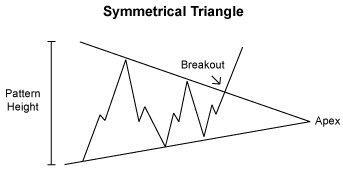
Symmetrical Triangle Pattern
To form your symmetrical triangle pattern, draw two converging trendlines that bound the high and low prices. Your trendlines should form (you guessed it) a symmetrical triangle, lying on its side.
How to Profit from Symmetrical Triangles
Symmetrical triangles are very reliable. You can profit from upwards or downwards breakouts. You’ll learn more about how to earn from downtrends when we talk about maximizing profits.
If you see a symmetrical triangle forming, watch it closely. The sooner you catch the breakout, the more money you stand to make.
Watch For:
• Sideways movement, a period of rest, before the breakout.
• Price of the asset traveling between two converging trendlines.
• Breakout ¾ of the way to the apex.
Set Your Target Price:
As with all patterns, knowing when to get out is as important as knowing when to get in. Your target price is the safest time to sell, even if it looks like the trend may be continuing.
For symmetrical triangles, sell your stock at a target price of:
• Entry price plus the pattern’s height for an upward breakout.
• Entry price minus the pattern’s height for a downward breakout.
**Note: All info was taken from Chart Advisor... here is just for reference.
Gold Heads for Best Monthly Gain Since November 2009 on Inflation, Dollar
Gold is poised for its biggest monthly advance since November 2009 as a weakening dollar and accelerating inflation prompted investors to buy precious metals as a store of value.
Immediate-delivery gold was little changed at $1,534.72 an ounce at 10:25 a.m. in Singapore after touching a record $1,540.85 an ounce earlier. The metal surged 6.8 percent this month. Bullion for June delivery in New York rose 0.2 percent to $1,534.80 an ounce, nearing yesterday’s record of $1,538.80.
“The sinking dollar is driving people to the gold market as speculators betting on a further rally are adding more fuel to the fire,” said Lim Han Jo, a Seoul-based trader with Tongyang Futures Co. “I don’t exclude the possibility of gold hitting $1,800 this year.”
The dollar fell to the lowest since December 2009 against the euro yesterday after the Federal Reserve kept borrowing costs at a record low. Assets in the SPDR Gold Trust, the biggest exchange-traded fund backed by gold, have expanded 1.5 percent this month, heading for the biggest gain since August.
The U.S. economy slowed more than forecast in the first quarter as government spending declined by the most since 1983 and household purchases cooled. Fed Chairman Ben S. Bernanke said this week the bank would maintain record monetary stimulus after ending large-scale bond purchases in June to spur growth.
Eighteen of 21 traders, investors and analysts surveyed by Bloomberg, or 86 percent, said bullion will rise next week. Three predicted lower prices.
‘Influencing Gold’
Gold has gained 8 percent this year, extending a decade- long advance, the best run since at least 1920, as the prospect of currency debasement and accelerating inflation fuel investor demand. Fighting in Libya and sovereign-debt turmoil in Europe have also contributed to the rally this year.
“Going forward, the direction of the dollar is still one of the main factors influencing gold,” said Ong Yi Ling, Singapore-based analyst with Phillip Futures Pte Ltd. “Dollar weakness may continue as the Fed is likely to err on the side of caution rather than tighten too early.”
Cash silver jumped 29 percent this month, the most since 1987, climbing to a record $49.79 on April 25. Silver last traded at $48.4575. Palladium gained 0.6 percent to $781.25, a 2.3 percent gain this month, while platinum was little changed at $1,843.75, a 4.3 percent advance for April.
Immediate-delivery gold was little changed at $1,534.72 an ounce at 10:25 a.m. in Singapore after touching a record $1,540.85 an ounce earlier. The metal surged 6.8 percent this month. Bullion for June delivery in New York rose 0.2 percent to $1,534.80 an ounce, nearing yesterday’s record of $1,538.80.
“The sinking dollar is driving people to the gold market as speculators betting on a further rally are adding more fuel to the fire,” said Lim Han Jo, a Seoul-based trader with Tongyang Futures Co. “I don’t exclude the possibility of gold hitting $1,800 this year.”
The dollar fell to the lowest since December 2009 against the euro yesterday after the Federal Reserve kept borrowing costs at a record low. Assets in the SPDR Gold Trust, the biggest exchange-traded fund backed by gold, have expanded 1.5 percent this month, heading for the biggest gain since August.
The U.S. economy slowed more than forecast in the first quarter as government spending declined by the most since 1983 and household purchases cooled. Fed Chairman Ben S. Bernanke said this week the bank would maintain record monetary stimulus after ending large-scale bond purchases in June to spur growth.
Eighteen of 21 traders, investors and analysts surveyed by Bloomberg, or 86 percent, said bullion will rise next week. Three predicted lower prices.
‘Influencing Gold’
Gold has gained 8 percent this year, extending a decade- long advance, the best run since at least 1920, as the prospect of currency debasement and accelerating inflation fuel investor demand. Fighting in Libya and sovereign-debt turmoil in Europe have also contributed to the rally this year.
“Going forward, the direction of the dollar is still one of the main factors influencing gold,” said Ong Yi Ling, Singapore-based analyst with Phillip Futures Pte Ltd. “Dollar weakness may continue as the Fed is likely to err on the side of caution rather than tighten too early.”
Cash silver jumped 29 percent this month, the most since 1987, climbing to a record $49.79 on April 25. Silver last traded at $48.4575. Palladium gained 0.6 percent to $781.25, a 2.3 percent gain this month, while platinum was little changed at $1,843.75, a 4.3 percent advance for April.
Gold Luring Central-Bank Buyers May Extend Record Rally

Central banks that were net sellers of gold a decade ago are buying the precious metal to reduce their reliance on the dollar as a reserve currency, signaling demand that may extend a record rally in prices.
As developing countries accelerate purchases, gold may reach $2,000 an ounce this year, compared with a record of $1,538.80 yesterday in New York, said Robert McEwen, the chief executive officer of producer U.S. Gold Corp. Euro Pacific Capital’s Michael Pento, who correctly predicted gold’s highs for the past two years, forecast a 2011 high of $1,600.
Prices reached a record 14 times this month on demand from investors seeking an alternative to the dollar after the currency slumped to the lowest since 2009, U.S. debt widened, and the Federal Reserve signaled April 27 that borrowing costs will remain near zero percent for an extended period. The economy in China, the biggest foreign holder of U.S. Treasuries, grew 9.7 percent in the first quarter.
“China is out to have more gold than America, and Russia is aspiring to the same,” McEwen said yesterday in an interview in New York. “When you have debt, you don’t have a lot of flexibility. China wants to show its currency has more backing than the U.S.”
In 2010, central banks became net buyers for the first time in two decades, adding 87 metric tons in official-sector purchases by countries including Bolivia, Sri Lanka and Mauritius, according to World Gold Council data. China, with more than $3 trillion in foreign-currency reserves, plans to set up new funds to invest in precious metals, Century Weekly reported this week. Russia purchased 8 tons of gold in the first quarter.
China’s Gold Reserves
China, which has just 1.6 percent of its reserves in gold, may invest more than $1 trillion in bullion, Pento said. “China wants to be an international player, and they need to own more gold than they currently have.”
The U.S. Treasury Department projects the government could reach its debt ceiling of $14.3 trillion as soon as mid-May and run out of options for avoiding default by early July. The Fed has kept its benchmark rate between zero percent and 0.25 percent since December 2008 to help stimulate the economy, driving the dollar down 11 percent against a basket of six major currencies during the past year.
“Until monetary policy changes, you’re going to continue to see gold go up,” said Michael Cuggino, who helps manage $12 billion at Permanent Portfolio Funds in San Francisco.
“Ultimately the best thing we can do to create strong fundamentals for the dollar in the medium term is first, keep inflation low, which maintains the buying power of the dollar, and second, create a stronger economy,” Fed Chairman Ben S. Bernanke said on April 27.
U.S. Reserves
As of April, China was the sixth-largest official holder of gold, with 1,054.1 tons, according to World Gold Council estimates. The U.S. has the most, with 8,133.5 tons, or 74.8 percent of the nation’s currency reserves, council data show.
Central-bank buying may have the same impact on gold as the introduction of exchange-traded funds, Cuggino said. Prices have more than tripled since the SPDR Gold Trust, the biggest ETF backed by bullion, was introduced in November 2004.
Central banks in emerging markets may aim to hold 2 percent to 8 percent of their foreign-currency reserves in gold, Francisco Blanch, the head of commodities research at Bank of America Merrill Lynch in New York, said in an interview.
Gold is “close to” its cyclical high, said Blanch, who expects the metal to average $1,500 this year.
Gold’s Enemies
“The enemies of gold are rising interest rates and a balanced budget,” said Pento of Euro Pacific Capital in New York. “I look for a summer swoon once Bernanke exits the bond market. You’re going to have a temporary rise in real interest rates.”
The Fed said it would buy $600 billion in U.S. Treasuries through June.
The Federal Funds rate would have to rise to “Volcker” levels before gold enters a bear market, said Gold Corp.’s McEwen, who expects the metal to rise to $5,000 over three to four years.
Prices have advanced 7.7 percent this year, extending a decade of gains in which gold jumped sixfold from a low in 1999. The all-time inflation adjusted record is $2,338.92, based on the value on Jan. 21, 1980, according to a calculator on the Web site of the Federal Reserve Bank of Minneapolis.
Former Fed Chairman Paul Volcker ended gold’s rally to a then-record $873 by raising borrowing costs to 20 percent in March 1980.
Silver Rally No Bubble as Price Will Top Record, Coeur d’Alene Chief Says
The rally in silver to a 31-year high in New York shows no sign of ending because tight supply and robust demand will send the metal to a record, according to Coeur d’Alene Mines Corp. (CDE), the largest U.S. producer.
“We’re in a legitimate market driven by financial interest in silver and strong industrial demand,” Chief Executive Officer Dennis Wheeler said today at the Bloomberg Link Precious Metals Conference in New York. “Supplies are relatively inelastic.”
Silver has surged 162 percent in the past year, outpacing the 31 percent gain in gold. Investment demand for silver jumped 40 percent in 2010 as inflation rose, currencies lost value and Europe’s debt crisis escalated, said researcher GFMS Ltd. Industrial use gained 21 percent last year and may climb to a record this year, London-based GFMS said.
The rally is “very different” from the surge in the late 1970s, when the Hunt brothers tried to corner the market, and in 1980, when prices touched a record $50.35 an ounce, Frank McGhee, the head dealer at Integrated Brokerage Services, said at the conference.
“There is no manipulation going on in this market,” McGhee said. “It does not take a lot to stop the market until this market decides to go. I’d like to categorize silver as a freight train.”
Silver futures for July delivery rose $1.554, or 3.4 percent, to close at $47.541 on the Comex in New York. Silver reached $49.845 on April 25.
Older Mines
Discovering new deposits has become more difficult, while “older mines cease production at a time when demand continues to grow,” said Wheeler, whose company is based in Coeur d’Alene, Idaho. High prices are not “a short-term phenomenon,” and the metal may jump to $55 by the end of 2011, he said. Integrated Brokerage’s McGhee predicted $62.
Not everyone is bullish on silver. William Hamelin, the president of Ames Goldsmith Corp., forecast a drop to $35.85 by year-end. Some manufacturers are “leaning” toward using more substitutes, including copper and nickel, after prices surged, he said.
Coeur d’Alene, which is based in the Idaho city of the same name, fell 51 cents, or 1.6 percent, to settle at $31.70 in New York Stock Exchange composite trading. The shares have jumped 84 percent in the past year, compared with a 19 percent gain for the Russell 2000 Index. (RTY)
“We’re in a legitimate market driven by financial interest in silver and strong industrial demand,” Chief Executive Officer Dennis Wheeler said today at the Bloomberg Link Precious Metals Conference in New York. “Supplies are relatively inelastic.”
Silver has surged 162 percent in the past year, outpacing the 31 percent gain in gold. Investment demand for silver jumped 40 percent in 2010 as inflation rose, currencies lost value and Europe’s debt crisis escalated, said researcher GFMS Ltd. Industrial use gained 21 percent last year and may climb to a record this year, London-based GFMS said.
The rally is “very different” from the surge in the late 1970s, when the Hunt brothers tried to corner the market, and in 1980, when prices touched a record $50.35 an ounce, Frank McGhee, the head dealer at Integrated Brokerage Services, said at the conference.
“There is no manipulation going on in this market,” McGhee said. “It does not take a lot to stop the market until this market decides to go. I’d like to categorize silver as a freight train.”
Silver futures for July delivery rose $1.554, or 3.4 percent, to close at $47.541 on the Comex in New York. Silver reached $49.845 on April 25.
Older Mines
Discovering new deposits has become more difficult, while “older mines cease production at a time when demand continues to grow,” said Wheeler, whose company is based in Coeur d’Alene, Idaho. High prices are not “a short-term phenomenon,” and the metal may jump to $55 by the end of 2011, he said. Integrated Brokerage’s McGhee predicted $62.
Not everyone is bullish on silver. William Hamelin, the president of Ames Goldsmith Corp., forecast a drop to $35.85 by year-end. Some manufacturers are “leaning” toward using more substitutes, including copper and nickel, after prices surged, he said.
Coeur d’Alene, which is based in the Idaho city of the same name, fell 51 cents, or 1.6 percent, to settle at $31.70 in New York Stock Exchange composite trading. The shares have jumped 84 percent in the past year, compared with a 19 percent gain for the Russell 2000 Index. (RTY)
Monday, 25 April 2011
Silver Surges to All-Time High on Inflation Hedge, Industry Use

Silver rallied to an all-time high as investors sought to protect their wealth against accelerating inflation and a weaker dollar with holdings in a metal that also benefits from economic growth.
Immediate-delivery silver climbed as much as 5.4 percent to $49.79 per ounce, surpassing the previous peak, which according to research company GFMS Ltd was $49.45 in January 1980. The metal traded at $49.2563 at 1:15 p.m. in Singapore, up for a ninth day and set for the longest winning run since an 11-day increase in March 2008. Spot gold also reached a record.
Precious metals have rallied on investor concern that central-bank programs to revive economic growth with record-low interest rates and increased supply of money will reignite inflation and hurt currencies including the dollar. Silver has more than doubled over the past year.
“It’s driven mainly by speculative buying, with investors eyeing the record for a while now,” Yang Shandan, a trader at Cinda Futures Co., said from Zhejiang, China. “We might get a bout of profit-taking now that we’ve pushed passed the high.”
July-delivery silver on the Comex in New York jumped as much as 8.2 percent to $49.845 per ounce, before trading at $48.730. The record was $50.35 an ounce, also set in January 1980, according to the exchange. Gold for immediate delivery climbed as much as 0.7 percent to $1,517.98 per ounce.
Subscribe to:
Posts (Atom)